

Tower Cranes & Hoists for Ras Al Khaimah's High-Rise Boom: Wynn Al Marjan & Beyond (2026)
RAK is the Northern Emirates' hottest lifting market, led by Wynn Al Marjan Island (~352m with its spire). The class of tower crane and hoist that scale demands — demand context only, no HOE involvement claimed.
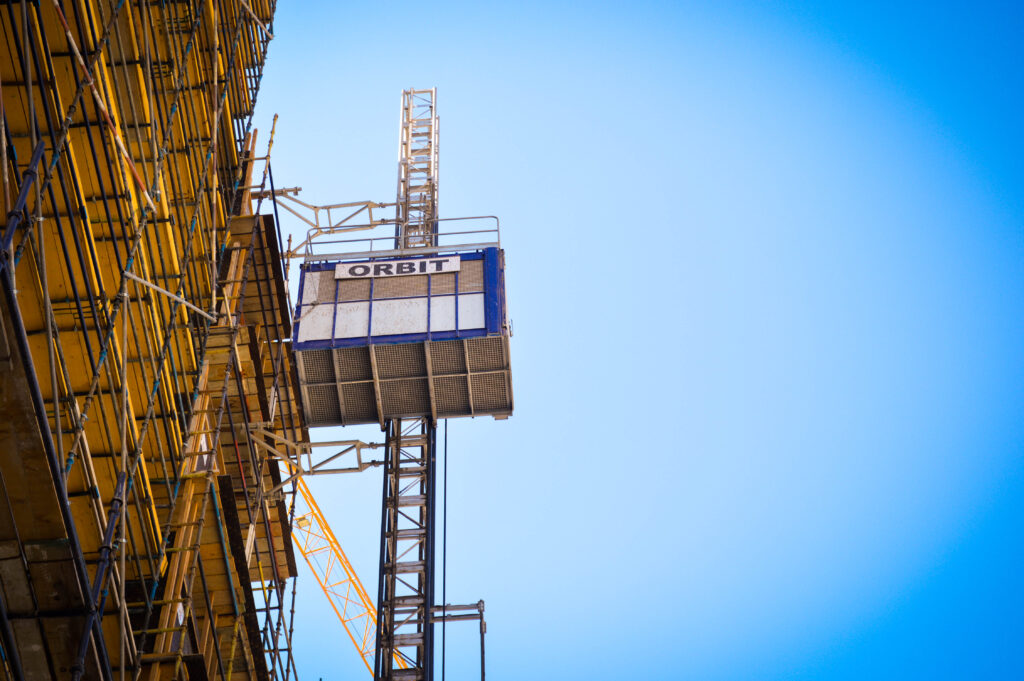
Ras Al Khaimah has quietly become the most interesting lifting market in the Northern Emirates. For years the emirate was associated with quarrying, ceramics and steady mid-rise residential work — useful demand, but not the kind that draws specialist tower-crane attention. That has changed. A wave of coastal high-rise on and around Al Marjan Island, anchored by the most-talked-about resort tower in the country, has pulled RAK into a different class of construction altogether, and with it a different class of lifting.
This guide is the honest version. It does not claim HOE supplied, erected or serviced any named project in RAK — we are a Dubai-based tower-crane and hoist specialist who serves Ras Al Khaimah from our Dubai base, and we frame the emirate’s headline developments only as market context for the scale of lifting they represent. What we can do is map the equipment to the demand: tell you what a 60-to-70-floor coastal tower actually needs, how serving RAK from Dubai works in practice, and what we need from you to recommend a crane or hoist for a RAK package. If you already know the spec and want a number, the tower crane rental hub and a quote request are the fast path — skip the article.
RAK’s skyline is changing fast: the demand picture (verify status)
The shift in Ras Al Khaimah is real, but the specifics move quarter to quarter, so treat every figure here as “as reported, confirm current status.” The centre of gravity is Al Marjan Island — a cluster of reclaimed islands off the RAK coast that has become the emirate’s prime high-rise and hospitality address. Around it sits a growing pipeline of resort, branded-residence and apartment towers, with the integrated-resort development at the head of the pack driving the most demanding lifts the emirate has seen.
Beyond Al Marjan, RAK’s wider build activity — mainland residential, hospitality and the infrastructure that supports a fast-growing tourism economy — keeps a steady base of mid-rise and high-rise work running. The point for equipment selection is not which single tower is tallest this year; it is that RAK has crossed from a mid-rise market into one that routinely needs high-capacity cranes and high-speed hoists. That is a structural change in the kind of equipment the emirate consumes, and it is unlikely to reverse even as individual project timelines shift.
It is worth being clear about what these projects are and are not for an equipment supplier. The tower cranes you may have seen on RAK’s flagship towers belong to other suppliers and rental houses — they are market context about the scale of the work, never a claim HOE can make. We reference them the way any honest supplier should: as the clearest illustration of the lifting envelope the RAK market now asks for, and as a prompt to spec equipment to that class rather than to an older mid-rise mindset.
Wynn Al Marjan Island as lifting context — scale, not a client claim
The single development that put RAK on the lifting map is the integrated resort on Al Marjan Island. As reported in mid-2026, the main tower topped out in December 2025 at roughly 283m structurally — about 352m to the tip of its spire — making it comfortably the tallest structure in the Northern Emirates, with opening reported for around spring 2027. Those numbers are as reported and should be confirmed against official sources before you rely on them; project statuses, heights and dates in the UAE change frequently.
To be unambiguous: HOE has no involvement in that project. We did not supply, erect or service it, and any cranes or hoists on it belong to other suppliers. We use it here purely as demand context — the clearest local illustration of what a tall, heavy, coastal resort tower demands from its lifting equipment. A structure of that height and complexity, on a reclaimed island with exposed marine conditions, sits squarely in the high-capacity, tie-in-and-climb, twin-cage-hoist class of work. That is the class of equipment we supply and the class this article is about.
The reason the distinction matters is more than legal caution. The whole value of an honest supplier guide is that you can trust the engineering judgement precisely because it is not dressed up as a sales claim. The resort tower tells you what the top of the RAK market looks like; the rest of this guide tells you what equipment that level of work needs and how we would deliver it.
What a 70-floor resort tower demands: luffing-jib and high-speed twin-cage hoists
Strip away the headline height and a 60-to-70-floor coastal tower comes down to two linked equipment decisions: the crane that builds the structure, and the hoist that moves crews and materials up it once the frame is rising.
On the crane side, a tall tower on a constrained island plot usually points toward a luffing-jib crane. A luffer pivots its jib up at the slewing platform rather than running a trolley along a horizontal jib, which dramatically shrinks the out-of-service footprint and lets the crane stow and slew inside a radius a flat-top could never manage. On a tight plot with neighbouring towers and over-sail restrictions, that is often the only configuration that physically fits. Where the plot and airspace are genuinely open, a heavier flat-top (topless) hammerhead in the 16-tonne-plus class can be the more efficient choice — lower rental, simpler operation, easier airspace sharing. The full trade-off across project archetypes is in our hammerhead vs luffing-jib comparison; the call is driven by airspace, not preference.
On the hoist side, a tall tower’s bottleneck is vertical transport. Once the structure is up, moving crews, tools and finishing materials up the face fast enough to keep every trade productive becomes the schedule-critical job, and on the tallest packages the answer is usually a twin-cage, high-speed construction and passenger hoist. A twin-cage unit runs two independent cages on one mast, roughly doubling throughput without doubling the footprint — the reason developers favour it where landing-level demand is relentless. The economics of twin-cage versus single-cage on tall buildings, and where the crossover sits, are worked through in our twin-cage vs single-cage hoist economics analysis; the framework holds for a RAK tower, sized to your build height and crew.
The summary table below maps RAK build types to the equipment class they typically demand:
| RAK build type | Crane class | Hoist class |
|---|---|---|
| 60–70 floor coastal resort/residence tower | Luffing-jib (tight plot) or heavy flat-top (open plot), 16 t+ | Twin-cage high-speed construction/passenger hoist |
| Mainland high-rise apartment tower | Flat-top hammerhead, mid-to-heavy, or luffing if congested | Single or twin-cage by height and crew size |
| Mid-rise residential / hospitality | Mid-size flat-top hammerhead | Single-cage construction hoist |
| Villa / low-rise cluster | Smaller flat-top, multiple units in parallel | Material hoist where needed |
Read the table as a starting point, not a spec. The right machine always falls out of the lift envelope and the OEM load chart, which is why we size against your actual parameters rather than a building-type rule of thumb.
Coastal and island sites: wind, salt and tight logistics
RAK’s most demanding lifting sits on the coast and on reclaimed islands, and that setting changes the engineering in three concrete ways.
Wind. Exposed coastal and island plots see higher, gustier winds than sheltered inland sites, and the Northern Emirates catch the same Shamal events as the rest of the country — strong north-westerlies that can suspend lifting and force cranes into weathervane (storm-survival) mode. The in-service and out-of-service wind regime, the weathervane arrangement and the operating limits matter more on a RAK coastal tower than on an inland mid-rise. We do not re-teach the wind mechanics here; the operating thresholds, Shamal behaviour and out-of-service set-up are covered in our tower-crane wind speed and Shamal storm guide.
Salt. Marine air accelerates corrosion of structural steel, wire rope, electrical cabinets and motors. On a coastal RAK job that raises the importance of marine-grade protection, disciplined wire-rope inspection and — critically — a genuine-OEM parts supply rather than uncertain aftermarket substitutes that may not hold up in a salt environment. Corrosion is a cost driver and a safety issue, not a cosmetic one.
Ground and access. Reclaimed-island ground often needs a piled or enlarged pad foundation, designed against the OEM reaction envelope by the project’s structural engineer. Island and coastal plots can also be tight on laydown and access, which constrains the assist-crane positions for erection and the staging of mast sections. None of this is exotic, but it all needs to be priced and planned rather than assumed.
The Dubai-to-RAK corridor: why serving RAK from Dubai works
Here is the honest part that some competitors blur: HOE does not have a yard, depot, office or fleet in Ras Al Khaimah. We operate from a single Dubai base and serve RAK — like the rest of the Northern Emirates — by mobilising up the road corridor as each job requires.
Far from a weakness, the single-base model is why it works. A tower-crane move to RAK is staged low-bed haulage of mast sections, the jib, counter-jib, slewing assembly and ballast up the Emirates Road / Sheikh Mohammed Bin Zayed Road corridor, followed by on-site erection with a mobile assist crane. RAK is one of the more accessible Northern Emirates runs from Dubai — road haulage is typically a matter of hours rather than days — but we deliberately do not publish a fixed transit or response time, because the real schedule is governed by oversized-load route permits, escort requirements, the assist-crane booking, site access and current equipment and crew availability, all of which are subject to traffic and the day.
Keeping one inspected, maintained pool of equipment and one technical team in Dubai behind every RAK job is more reliable than thin satellite stock would be, and it means a RAK client gets the same specialists, the same genuine-OEM parts depth and the same 24/7 breakdown cover as a Dubai client — just delivered up the road. The mechanics of cross-emirate and cross-border mobilisation, and how to read mobilisation as a cost line, are part of the broader picture our companion Sharjah and Northern Emirates crane-and-hoist supplier guide sets out.
RAK approvals at a glance — RAK Municipality and RAKEZ (confirm locally)
A Dubai permit does not carry into Ras Al Khaimah, and RAK runs its own approval layers. At a glance:
- RAK Municipality owns building control and construction approvals on mainland and most island plots, and the tower-crane location and lift plan sit within that municipal process.
- RAKEZ (Ras Al Khaimah Economic Zone) governs sites inside its free-zone footprint, with its own construction health, safety and environment requirements — so which desk reviews your job depends on where the plot sits.
We deliberately do not state RAK permit steps, fees or timelines as fixed facts. The honest position is “confirm the current requirement with RAK Municipality or RAKEZ before you submit,” because the rules, editions and processes change and vary by plot. What broadly carries across the UAE — third-party inspection regimes, operator competency, and the engineering standards behind the lift plan — is the layer where the deep existing guides apply directly. For the RAK and RAKEZ detail set against the rest of the north, see our Sharjah and Northern Emirates municipality and free-zone approvals guide; for how the UAE-wide fundamentals fit together, lean on the established compliance and inspection posts rather than treating RAK as a blank slate.
Multi-crane and long-term hire thinking for a RAK programme
A single resort tower is rarely a single-crane job, and a cluster of towers on Al Marjan is a multi-crane, multi-month programme. Once a RAK site needs two or more cranes sharing overlapping airspace, single-unit rental thinking breaks down: the fleet has to be sized against the floor cycle and peak concurrent lift demand, the hammerhead-and-luffing mix planned for the airspace as one exercise, anti-collision specified where jibs overlap, and erection and dismantle windows sequenced across the programme. That is a different conversation from hiring one crane, and it is the subject of our multi-crane fleet hire for UAE & GCC mega-projects guide.
Two commercial points are worth flagging for a RAK programme specifically. First, committed duration is the single biggest lever on the per-month rate after crane class — a defined long programme earns a better per-month rate than a short or open-ended hire, because the one-off mobilisation, erection and dismantle costs amortise over a longer term and the supplier can plan around your dates. Second, the further north and the more island-constrained the site, the more mobilisation and laydown logistics matter, so engaging early protects both your structural-frame milestones and your number. The way a RAK tower’s lifting demand sits within the wider UAE picture — supertall Dubai work, Palm villa clusters, Abu Dhabi islands — is mapped in our UAE megaprojects and supertall lifting-demand guide, again as demand context, never as a client list.
Scoping a RAK lift with HOE
To recommend a crane class, a luffing-versus-flat-top call, a hoist configuration or a parts and breakdown package for a Ras Al Khaimah job, here is what we need from you:
- Site location within RAK (Al Marjan Island, mainland RAK City, a RAKEZ plot, elsewhere) and whether it is coastal or reclaimed ground
- Building height and floor count, or structure type for non-building work
- Heaviest scheduled lift — weight, radius and the level it lands on
- Plot constraints — adjacent towers, over-sail limits, airspace conflicts, laydown and access
- Programme length, floor cycle and, for hoists, crew size and number of landing levels
- Any preference on buy versus rent, brand, or a single supplier across a multi-crane cluster
Send those and we come back with a recommended crane and hoist spec, a load-chart fit-check, the foundation reaction envelope to hand to your structural engineer, parts and logistics support, and an indicative AED figure — not a fixed published price, because every RAK package is different and an honest number has to follow your actual scope. As a RAK supplier we compete on multi-brand choice across YONGMAO, POTAIN, ZOOMLION, XCMG and SYM cranes and GJJ and ORBIT hoists, genuine OEM parts depth, and the engineering judgement to match equipment to a coastal high-rise — not on a local fleet we do not have.
Getting started
If you are scoping a Ras Al Khaimah lift — an Al Marjan Island tower, a mainland high-rise or a RAKEZ build — talk to a tower crane supplier serving Ras Al Khaimah from a Dubai base, and send us the lift parameters so we can recommend the right class of equipment. For sale, rental, erection, climbing, dismantling, parts and service across the emirate, our full service offer is on the services page. Sales: +971 50 144 4810. For an existing crane or hoist that needs parts, maintenance or emergency support on a live RAK site, the 24/7 breakdown line is +971 50 641 5819, and you can reach the team at inquiry1@hoe.ae.
Tell us about the project and request a quote — we will respond with a spec and an AED figure, and we will be straight with you about what the equipment can and cannot do, and about the fact that we serve RAK from Dubai. The FAQs below cover the questions we are asked most on Ras Al Khaimah lifting, from Al Marjan mobilisation to the RAK and RAKEZ approval split.
People Also Ask
Frequently Asked
Can HOE supply and erect a tower crane on Al Marjan Island?
Is HOE involved in Wynn Al Marjan Island?
What tower crane class do RAK high-rise towers need?
How is a crane mobilized from Dubai to Ras Al Khaimah?
Does coastal/island work change wind and crane requirements?
Does RAK have different crane regulations than Dubai?
Does HOE keep a yard or fleet in Ras Al Khaimah?
Need this on a real site?