

Tower Cranes & Hoists for Saudi Giga-Projects: NEOM, Qiddiya, Diriyah & Red Sea Scale
Vision 2030 giga-projects drive the heaviest lifting demand in the GCC. The honest version — what class of tower crane and hoist megastructure work needs, and how HOE's heavier range maps to it.
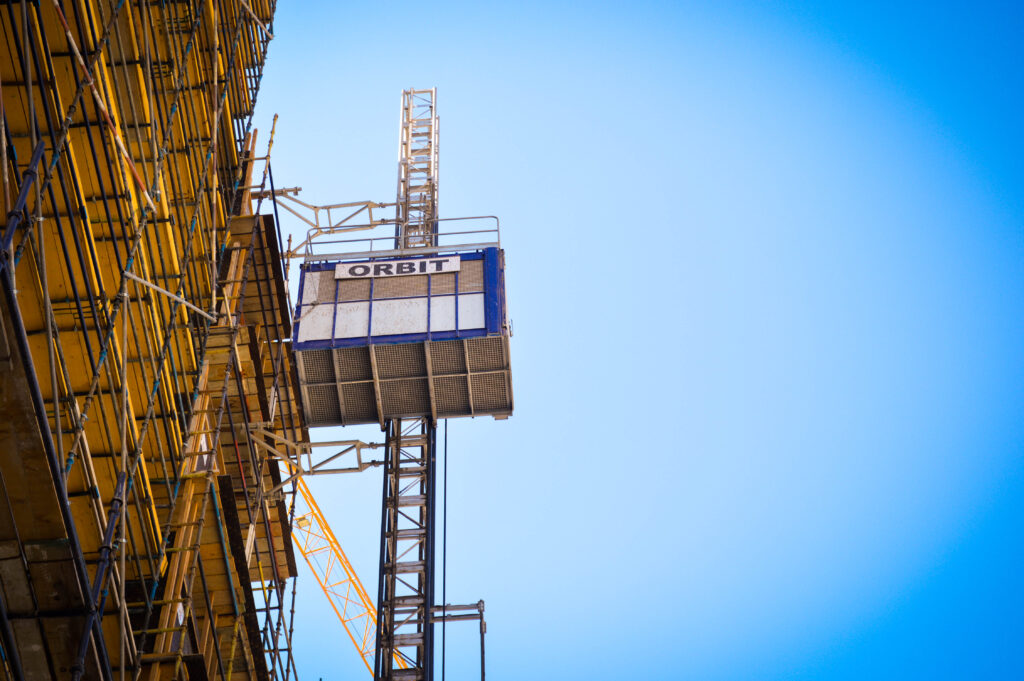
Saudi Arabia’s Vision 2030 pipeline is the single largest concentration of heavy lifting demand in the GCC, and it has reshaped what “a big crane job” means in the region. When people say a project needs “NEOM-scale” lifting, what they actually mean is a specific class of equipment: high-capacity flat-top and luffing-jib tower cranes, twin-cage construction hoists, and the logistics to put them on sites that are sometimes hundreds of kilometres from the nearest port.
This guide is the honest version. It does not claim HOE supplied any named giga-project — we are a GCC-wide supplier serving Saudi Arabia from our Dubai base, and we frame these programmes as market context for the class of lifting challenge they represent, nothing more. What we can do is map the equipment to the demand: tell you what megastructure and super-tall work genuinely requires, where our heavier range fits, and what we need from you to recommend a crane or hoist for a Saudi package. If you already know the spec and want a number, the products hub and a quote request are the fast path — skip the article.
The 2026 reality check: which Saudi giga-projects are actually active
The honest starting point is that the giga-project landscape in mid-2026 is not the one the early renders promised. Programmes that are widely reported as currently active and pulling heavy construction equipment include Qiddiya (the entertainment and sports city southwest of Riyadh), Diriyah Gate (the cultural and heritage district on Riyadh’s western edge), ROSHN’s residential communities across several cities, and Red Sea Global’s coastal tourism developments. These are the programmes to anchor demand framing to, because their construction activity is comparatively well documented.
Project status in Saudi Arabia changes fast, and any guide that treats a render as a delivery date will age badly. Verify the current position of any specific programme against official government and developer sources before you build a procurement plan around it. What does not change is the underlying point for equipment selection: super-tall buildings, long-span structures and dense multi-tower districts all demand a particular class of crane and hoist, regardless of which masthead project happens to be running this quarter.
It is also worth being clear about what these projects are and are not for an equipment supplier. Genuine third-party tower-crane deployments on Saudi flagship work — the cranes you may have seen on the tallest towers and on island resorts — belong to other suppliers and rental houses; they are market context about the scale of the work, never a claim HOE can make. We reference giga-projects the way any honest supplier should: as the clearest illustration of the lifting envelope the Saudi market now routinely asks for, and as a prompt to spec equipment to that class rather than to a smaller city-build mindset.
The recalibrated picture: The Line suspended, Mukaab halted
Two widely-reported recalibrations are worth naming because they change how you should read crane-demand headlines. The Line — the linear-city centrepiece at NEOM — was reported through late 2025 as significantly scaled back, with its broader vision pushed out on the timeline. The Mukaab cube tower in New Murabba was reported in early 2026 as halted or reprioritised. Both should be confirmed against current sources rather than taken from this page, but the direction of travel is clear enough.
For demand framing this matters in one specific way: do not size a fleet, or a business case, against a single flagship structure that may be paused. Anchor to confirmed-active programmes and to the steady-state reality that Saudi Arabia is building a very large volume of high-rise residential, commercial, hospitality and infrastructure work that needs cranes whether or not the most futuristic projects proceed on their original schedule. Treat any crane-count figure you see quoted for a giga-project — “80-plus cranes”, “up to twenty thousand workers” — as an industry estimate, not a fact.
What “giga-project-scale” lifting actually requires
Strip away the marketing and giga-project lifting comes down to four engineering drivers:
- Capacity at radius. The headline tip load is the least useful number. What matters is the heaviest scheduled lift — a full concrete bucket, a formwork table, an MEP plant skid, a precast or façade module — delivered at the radius it actually lands. Size on the lift envelope, with margin, not on the brochure tip load.
- Reach and free-standing height. Super-tall work pushes cranes well past their free-standing limit, which means tie-ins or internal climbing, and tie reactions the structural engineer has to design for.
- Multi-crane, tight-radius sites. Megaproject plots routinely run several cranes with overlapping slew radii, which forces anti-collision systems and often luffing jibs to manage airspace.
- Peak lift rate. A dense district pour can run dozens of lifts per shift per crane; when the rate exceeds what one machine can sustain, you add cranes, not size.
The discipline of working through these is identical to any serious build — the giga-project difference is scale and repetition. Our UAE tower crane selection guide walks the full lift-envelope method step by step; the engineering transfers directly to Saudi packages, with the regulatory and power-supply overlay swapped to the KSA framework.
High-capacity luffing-jib cranes for congested and super-tall work
Luffing-jib cranes pivot the jib up at the slewing platform rather than running a trolley along a horizontal jib. The payoff is a much tighter out-of-service footprint: a luffer can stow with its jib raised and swing inside a radius a flat-top could never manage. On a congested giga-project plot with adjacent towers, overlapping cranes and restrictions on over-sailing neighbouring parcels, that is often the only configuration that physically fits.
The trade-offs are real and worth stating plainly. Luffing capex and rental run materially higher than an equivalent-capacity flat-top, operator training is longer, and the load chart drops faster as the jib angle changes — so the lift planning is less forgiving. You move to luffing when the airspace forces it, not as a default. The full trade-off across project archetypes is in our hammerhead vs luffing-jib comparison, and reading a load chart properly — which is where luffing cranes catch people out — is covered in the load charts and lifting capacity guide.
Flat-top (topless) cranes and the developer preference for heavier classes
For the large volume of giga-project work that is not airspace-constrained — wide low-rise districts, mid-rise residential blocks, infrastructure with open airspace — the flat-top (topless hammerhead) is the efficient workhorse. Dropping the A-frame above the jib lowers the over-all height, makes erection at height simpler and makes airspace sharing between adjacent cranes easier. On a programme building hundreds of structures in parallel, the flat-top’s lower rental and simpler operation compound into a significant cost advantage.
Where megastructure and super-tall packages are concerned, the developer preference tends to move up into the 16-tonne-plus and 24-tonne classes, because the peak lifts — full slab pours, heavy plant, large precast — demand it. The crane brands that cover this envelope, and the spare-parts and resale realities behind each, are compared in our tower crane brands comparison — read it before committing a brand, because spec-to-spec the cranes look similar but parts depth and operator familiarity differ materially across a long programme.
Twin-cage and high-speed construction hoists for super-tall vertical transport
On a super-tall build the tower crane is only half the vertical-transport problem. Once the structure is up, the bottleneck becomes moving crews, tools and finishing materials up the face fast enough to keep every trade productive. That is the job of the construction and passenger hoist, and on the tallest packages the answer is usually a twin-cage, high-speed unit.
A twin-cage hoist runs two independent cages on the same mast, which roughly doubles throughput without doubling the footprint — the reason developers favour it on the tallest towers where landing-level demand is relentless. Selection turns on cage payload, hoisting speed, mast height and the number of landing levels served. HOE supplies GJJ and ORBIT construction and passenger hoists for exactly this class of work. The economics of twin-cage versus single-cage on tall buildings — and where the crossover sits — are worked through in our twin-cage vs single-cage hoist economics analysis; the framework holds for Saudi towers, sized to your build height and crew.
Where HOE’s range fits
We position our heavier range as equipment suited to giga-project-scale and super-tall work — not as a claim of involvement in any named programme. In practice that means:
| Demand | Equipment class HOE supplies |
|---|---|
| Heavy peak lifts on tall towers | Heavier YONGMAO STT/STL flat-top and luffing cranes, ZOOMLION and XCMG hammerheads in the 16–25 t+ envelope |
| Congested, airspace-restricted plots | Luffing-jib configurations to manage tight slew radii and over-sail limits |
| Wide low-rise / mid-rise districts | Flat-top (topless) hammerheads for efficient parallel deployment |
| Super-tall vertical transport | GJJ and ORBIT twin-cage and high-speed construction/passenger hoists |
| Ongoing uptime | Genuine OEM spare parts and 24/7 breakdown support |
We supply all of this for Saudi Arabia from our Dubai depot through GCC logistics, and we compete on multi-brand choice, genuine OEM parts depth and cross-border spec expertise — not on a local Saudi fleet. The full commercial picture for the Kingdom, including sale, rental, parts and service in SAR, sits on our tower crane supplier in Saudi Arabia hub.
Remote-site logistics: getting equipment to NEOM-region, Red Sea and Eastern Province sites
A real difference between giga-project work and a city-centre build is distance. A package in the NEOM region (Tabuk Province, in the far northwest), on the Red Sea coast, or out in the Eastern Province can sit a long way from the nearest port and from any equipment yard. That changes the logistics maths: mobilisation, erection and dismantle costs rise with distance, escorted oversized-load convoys need route permits, and lead times stretch.
There is also a sequencing consideration that is easy to miss. On a programme erecting many structures in parallel, the cranes do not all arrive at once — the early packages pull from whatever depot stock can be mobilised fastest, while later units can run factory-direct because the schedule gives them the lead time. Getting that mix right protects the structural-frame milestones on the first buildings without over-committing capital to a fleet that sits idle waiting for its package to start. The dismantle sequence matters just as much on a remote site, where demobilisation convoys compete for the same escorted-route permits the inbound loads needed.
The practical implication is to plan equipment delivery against the construction programme early, stage the first cranes from depot stock where possible, and accept that remote-site mobilisation is a cost driver in its own right. The full SAR cost picture for Saudi rental — including how mobilisation to remote sites loads the number — is broken down in our tower crane rental cost in Saudi Arabia 2026 guide. We do not publish fixed prices because every package is different; we quote against your actual scope.
Compliance overlay on giga-project sites: HCIS, SBC and 60 Hz
Giga-project sites carry a compliance overlay that a standard commercial build does not, and it is worth flagging before equipment ever ships:
- HCIS. Work inside or adjacent to certain industrial facilities falls under the High Commission for Industrial Security, which governs industrial-site security and safety. Aramco-adjacent scopes typically add client inspection and induction requirements on top of the standard framework. Confirm the applicable HCIS and client conditions with the project safety lead and asset owner — do not assume a commercial permit pack covers an industrial scope. The Saudi inspection and certification picture, including the Aramco and HCIS overlay, is detailed in our Saudi tower crane third-party inspection guide.
- Saudi Building Code. Crane foundation, tie-in and structural design on a Saudi site sit under the SBC, signed off by a Saudi-licensed engineer — a different basis from the UAE framework. Verify the applicable chapter and edition for your project.
- Power frequency. Much of Saudi Arabia runs on 60 Hz where the UAE runs on 50 Hz, which has direct implications for hoist, slewing and trolley motors and their drives. A crane specced for a 50 Hz UAE site is not a drop-in for a 60 Hz Saudi one — verify your site supply and SEC region. We cover the trap in detail in 50 Hz vs 60 Hz tower crane and hoist motors. Confirm exact behaviour with the OEM and the Saudi Electricity Company.
Treat all of the above as “confirm with the relevant authority, SASO conformity body, the OEM and SEC” rather than as settled rules — the Saudi framework is genuinely distinct from the UAE one HOE’s other guides cover, and the specifics move.
How to brief HOE on a giga-project lift
To recommend a crane class, a luffing-vs-flat-top call, a hoist configuration or a parts package, here is what we need:
- Package location and region (Riyadh, Jeddah, Dammam/Al Khobar, Mecca, Medina, the NEOM/Tabuk region, Red Sea coast) and whether it is an industrial/Aramco-adjacent scope
- Building height (m) and floor count, or structure type for non-building work
- Heaviest scheduled lift — weight, radius and the level it lands on
- Plot constraints — adjacent cranes, over-sail limits, airspace conflicts
- Peak lift rate from the programme, and for hoists the crew size and landing levels
- Project duration, and any preference on buy vs rent or brand
- Site power supply (50 Hz / 60 Hz) and SEC region
Send those and we will come back with a recommended crane and hoist spec, a load-chart fit-check, the foundation reaction envelope, parts and logistics support, and an indicative SAR figure — not a fixed published price, because giga-project packages vary too much for that to be honest.
Getting started
If you are scoping a Saudi giga-project package — or any super-tall or megastructure build across the GCC — send us the lift parameters and we will recommend the right class of equipment. Sales: +971 50 144 4810. For an existing crane or hoist that needs parts, maintenance or emergency support on a live site, the 24/7 breakdown line is +971 50 641 5819, and you can reach the team at inquiry1@hoe.ae.
Tell us about the package and request a quote — we will respond with a spec and an SAR figure, and we will be straight with you about what the equipment can and cannot do. The FAQs below cover the questions we get asked most on giga-project lifting, from crane counts to HCIS clearances.
People Also Ask
Frequently Asked
How many tower cranes does a giga-project like NEOM need?
What class of tower crane suits super-tall and megastructure work?
Is The Line at NEOM still being built in 2026?
What construction hoist is best for super-tall buildings on Saudi projects?
What is the difference between a hammerhead and a luffing-jib crane for tight megaproject sites?
Do crane operations on Aramco-adjacent industrial sites need HCIS approval?
Does HOE supply tower cranes and hoists to Saudi giga-projects?
Need this on a real site?