

Tower Crane Spare Parts in the UAE: A Procurement Buyer's Guide (2026)
Same parts, three sourcing paths, three very different cost-and-lead-time outcomes. The working procurement guide for tower crane spare parts in the UAE — written for the people who actually sign the POs.
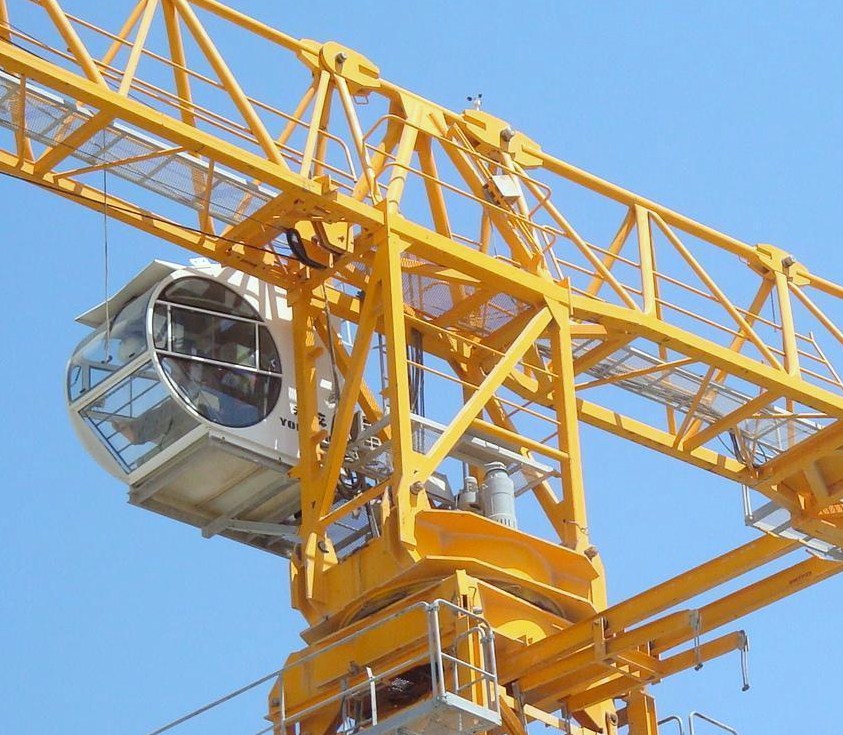
The spare-parts purchase that costs the least is rarely the one priced lowest. On a tower crane that’s grossing AED 4,000–12,000 per operating day, two weeks of downtime waiting on a part dwarfs whatever was saved by going OEM-direct via sea freight from Tianjin.
This guide is the procurement playbook for tower crane spare parts in the UAE — written from the supplier side but with the buyer’s cost calculation in mind. It covers the three sourcing paths, real lead times, the customs and HS code mechanics, the compatibility checks that prevent shipping the wrong SKU, and the procurement mistakes we see most.
If you’re scoping a project and need the foundational sizing decisions first, start with the L46A1 vs L68B sizing guide and the L68B grade selector. This piece picks up from there: assuming you know what you need, how do you actually buy it?
The three sourcing paths
Every tower crane spare part in the UAE arrives via one of three routes. They have very different cost, lead-time and risk profiles.
Path 1 — Locally stocked by a UAE supplier
Parts physically in a Dubai or Sharjah depot, available for same-day or next-day dispatch within the UAE and 2–5 days to wider GCC. HOE operates on this model for the high-frequency inventory: mast sections (L46A1, L68B1/B2/B3), climbing cages, tie collars, fixing angles, common motor sizes, gearboxes, inverters, brake assemblies, slewing rings.
Cost: 15–35% premium over OEM-direct (the supplier carries inventory cost). Lead time: hours, not weeks. Risk: lowest — the supplier has already taken on inventory risk + quality control. When it wins: unplanned breakdowns, critical-path replacements, “we need it on a trailer by 09:30.”
Path 2 — OEM-direct from China or Europe
Order placed with the original manufacturer (Yongmao in Tianjin, Potain in France via the Manitowoc distribution network, Zoomlion in Changsha, XCMG in Xuzhou). Part ships from the OEM warehouse via airfreight or sea.
Cost: lowest unit price (typically). Lead time: 4–8 weeks China sea / 7–14 days China air / 2–4 weeks Europe air. Risk: moderate — customs delays, freight delays, occasional damage in transit, plus the substantial risk that the part doesn’t fit when it arrives. When it wins: planned bulk orders (full mast stacks for new deployments), unusual parts not held in regional stock, projects with long lead-time tolerance.
Path 3 — Second-hand from end-of-project supply
Parts coming off projects that have completed — mast sections, climbing cages, motors, sometimes whole crane configurations. UAE has a healthy second-hand market because the volume of project starts and finishes keeps inventory turning over.
Cost: typically 45–65% of new OEM price, sometimes lower. Lead time: depends entirely on what’s available — could be immediate, could be never. Risk: highest if poorly sourced — fatigue history, undocumented overload events, grey-market sections without OEM provenance. Acceptable with rigorous inspection. When it wins: non-structural wear items (motors, gearboxes), L68B3 mast sections with generous safety margin, complete crane purchases on a budget.
We help clients pick the right path on a part-by-part basis. Sometimes the answer is a mix: local stock for the urgent structural items, OEM-direct bulk for the planned long-tail, second-hand for one specific item that the second-hand market happens to have at favourable price-and-condition right now.
Real lead times by part category
Indicative for 2026 in the UAE. Lead times exclude any in-country installation work.
| Part category | Locally stocked (HOE Dubai) | OEM-direct China | OEM-direct Europe |
|---|---|---|---|
| Mast sections (L46A1, L68B family) | Same day UAE; 2–5 days GCC | 5–8 weeks sea, 2 weeks air | n/a |
| Climbing cages | Same day UAE; 2–5 days GCC | 6–8 weeks sea, 2 weeks air | 3–5 weeks air |
| Tie collars, fixing angles | Same day UAE; 2–5 days GCC | 5–7 weeks sea | 3–4 weeks air |
| Slewing rings | 1–3 days UAE (sometimes ex-stock) | 6–10 weeks sea, 2 weeks air | 3–6 weeks air |
| Hoist motors (common ratings) | Same day UAE | 4–6 weeks sea, 1–2 weeks air | 2–4 weeks air |
| Slewing motors / gearboxes | 1–3 days UAE | 4–6 weeks sea, 2 weeks air | 2–4 weeks air |
| Inverters / control panels | 2–5 days UAE | 6–10 weeks sea, 2–3 weeks air | 4–8 weeks air |
| LMI / safety electronics | 1–2 weeks (regional sourcing) | 6–12 weeks (OEM software keys) | 4–8 weeks |
| Custom-engineered drum / boom parts | 2–4 weeks (regional sourcing) | 8–14 weeks | 6–10 weeks |
The reason locally-stocked dominates the urgent end of this table isn’t magic — it’s that HOE has already eaten the 4–8 week wait by holding the inventory. You pay a margin for that; the question is whether the margin is less than the downtime cost.
For a 16 t crane at typical Dubai high-rise day rates, downtime cost is roughly AED 5,000–12,000 per day including operator standby, lift schedule disruption, and the cascade into other trades waiting on the crane. Two weeks of waiting on a part = AED 70,000–168,000 of downtime cost. A part costing AED 25,000 vs AED 32,000 (the 28% local premium) saves AED 7,000 — but loses AED 140,000+ if you waited two weeks for it.
This calculation is the entire reason a Dubai-stocked supplier exists.
Customs, HS codes and the paperwork that delays shipments
UAE imports of tower crane spare parts run through customs the same way any industrial machinery part does — with a few quirks.
The HS code that fits most parts is 8431.49 — “Parts of machinery of headings 8425
to 8430 (cranes, mobile lifting frames, etc.)”. Sub-codes apply for specific items:
8431.41.00— Buckets, shovels, grabs (relevant for some hoist applications)8431.43.00— Parts of boring or sinking machinery8431.49.00— Other crane/lifting machinery parts (the catch-all for tower crane parts)8483.40— Gears and gearing (when invoiced separately as a sub-assembly)8501.52— AC motors of an output > 750 W (when invoiced as standalone motor units)
Standard duty rate: 5% of CIF value. VAT: 5%. Total: ~10.25% on landed value when both apply.
Where it can go wrong:
-
Wrong HS code — using a generic “machinery parts” code instead of
8431.49can trigger a customs query and 3–7 days of delay. Some grey-market suppliers use the generic code to avoid scrutiny; we don’t, because the delay is worse than the small duty difference. -
Inadequate description — the commercial invoice has to describe the part well enough for customs to verify the code. “Crane parts” is not enough; “Mast section L68B2, Yongmao-compatible, 3 m length, Q345B steel, weight 2,100 kg” is the kind of detail that clears in hours.
-
Missing certificate of origin — required for GCC-preferential rates if you’re re-exporting to KSA / Qatar / Oman. UAE-issued certificate is straightforward if your supplier is set up for it; an absent certificate means you pay full GCC duty on arrival.
-
VAT registration mismatch — buyer’s TRN (Tax Registration Number) needs to be on the commercial invoice. Missing TRN = your supplier pays import VAT, then you pay them back, and you cannot reclaim it cleanly.
The HOE-stocked path bypasses all of this — by the time the part is in our Dubai depot, customs has already cleared. You get a UAE-issued invoice with VAT shown and a delivery note. That’s the entire paperwork chain.
Compatibility — how to make sure you order the right SKU
The single most expensive procurement mistake we see: a contractor orders a part by description (“mast section for our Yongmao”) without verifying the OEM SKU. The part arrives, doesn’t fit, and now you’ve paid for the wrong part and are still waiting for the right one.
The compatibility check, in order of authority:
-
Crane model + serial number from the OEM data plate. This is the canonical reference. The data plate is bolted to the slewing platform on most cranes — accessible from the cab. Take a photo.
-
Part designation from the OEM parts manual for that model. Every OEM publishes a parts catalogue with diagrams and SKU numbers — your maintenance team should have it. If you don’t have it, HOE can usually source the relevant diagram.
-
For wear parts, the OEM data sheet on the existing part. Motors carry a nameplate with rated power, voltage, torque, shaft dimensions, frame size. Match those exactly. Photograph the nameplate; we can identify the OEM SKU.
-
For mast sections specifically: dimension check + grade check. Confirm 1.6 m square (L46) vs 2.0 m square (L68). For L68B, specify B1, B2 or B3 explicitly per the grade guide. Never accept “L68B” with no grade.
-
For structural parts in general: demand the OEM material certificate and the serial number stamping. Both should be visible at delivery. Refuse shipments that lack them.
A common shortcut: send photos of the worn part with measurements. HOE engineers can identify the OEM SKU from a few good photos for almost any common crane in 80%+ of cases. That photo-to-SKU service is free with any RFQ.
The procurement mistakes we see most
After several hundred parts orders across MENA, four mistakes show up over and over:
-
Optimising for unit price instead of landed cost — the cheapest invoice often becomes the most expensive job once you add airfreight, customs delays, and downtime. Always quote in landed-cost terms.
-
No traceability on grey-market structural parts — the savings on a no-name L68B section vanish the moment a structural engineer refuses to sign off without OEM provenance. Then you’re paying twice.
-
Ordering by description, not by SKU — “Yongmao mast section” buys you something that might not fit. “Mast section L68B2, Yongmao STT293-compatible, 3 m, Q345B” buys you something that does.
-
Underestimating shipping time on bulk OEM-direct orders — UAE construction schedules don’t tolerate a six-week wait. For anything on the critical path, buy local or build the wait into the plan from day one.
What we keep in Dubai stock
The HOE depot in Dubai carries inventory across five categories — the parts that come off working cranes and need replacing fast. The spare-parts hub page has the current category list with full descriptions, but in summary:
- Mast sections — L46A1, L68B1, L68B2, L68B3, L69B variants, mast bolts and pin sets
- Climbing & anchoring — climbing cages, tie collars, fixing angles, anchor frames
- Drive & power — slewing motors, hoist motors, gearboxes, trolley motors, inverters, control panels
- Safety & limits — LMI units, anti-collision, limit switches, brakes, hook blocks
- Construction hoist parts — GJJ and ORBIT cabin parts, mast tubes, guide rollers, motors, and the anti-fall safety devices (SAJ40 / SAJ60 progressive governors) that are mandatory on every passenger / material hoist and must be replaced every 3 years regardless of usage. See the construction hoists hub for the dedicated procurement view — same Dubai depot, same dispatch lead times, same engineering crew on the breakdown line.
For anything not on the regular stock list, we source from a network of OEM warehouses on 1–4 week lead.
How to get a quote
Three pieces of information get you a fixed-price quote in 48 hours:
- Crane make, model and serial number (photo of the data plate is fine)
- Part list with OEM designations where you have them, or photos of the worn parts with measurements
- Target delivery date and site location
Send to sales +971 50 144 4810 or the contact form. For cranes already on site with a part needed right now, that’s the 24/7 breakdown line: +971 50 641 5819.
The cluster’s hub page collects every spare-parts guide as it lands — worth bookmarking if you handle procurement for an active MENA tower crane fleet.
People Also Ask
Frequently Asked
How long does it take to get a tower crane spare part in the UAE?
Which tower crane parts have the longest lead times?
Do I need to pay customs duty on tower crane spare parts imported into the UAE?
Can I import tower crane parts directly from the OEM in China and save money?
How do I know if a spare part is compatible with my specific crane?
What's the difference between genuine OEM and 'OEM-compatible' / aftermarket parts?
Can I get a quote without committing to buy?
Need this on a real site?